
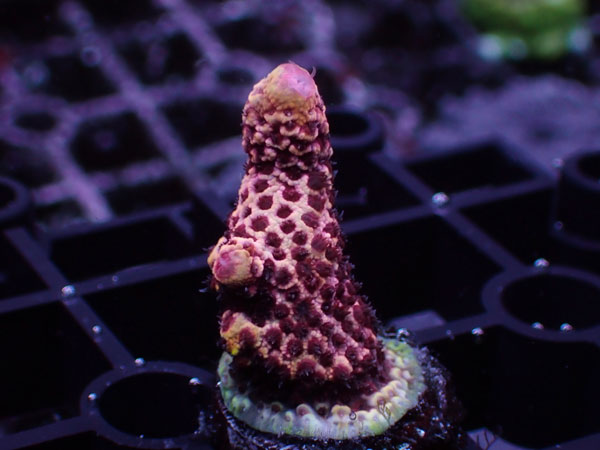

Why PC Rainbow Acropora stands out
PC Rainbow Acropora is a classic in the reef hobby, prized for its ability to develop a true, vibrant orange color that is rare among SPS corals. Unlike many other Acropora varieties that rely heavily on blue hues, this strain offers a distinct warm palette that can shift between orange and purple depending on the lighting spectrum and nutrient balance in your tank.
This color-shifting nature makes it a dynamic centerpiece. Under strong blue and UV light (350–450 nm), the polyps often display intense orange tones, while adjustments in white or red light can bring out purple undertones. The visual reward is significant, but it requires precise care. These corals are sensitive to water quality and susceptible to issues like rapid tissue necrosis (RTN) if conditions fluctuate.
When provided with favorable conditions—stable parameters, adequate flow, and appropriate lighting—PC Rainbow Acropora rewards the aquarist with rapid growth and stunning coloration. It is not just a static decoration; it is a living canvas that responds directly to your tank's environment, making it a prized addition for those willing to master its specific needs.
Setting up lighting for peak color
Lighting is the primary trigger for the PC Rainbow Acropora’s signature orange and purple fluorescence. To bring out these colors without bleaching the coral, you need to balance intensity with spectrum. The goal is to provide enough energy for the zooxanthellae to thrive while stimulating the coral’s fluorescent proteins.
Aim for a PAR (Photosynthetically Active Radiation) range of 250–400. This intensity is strong enough to support growth but gentle enough to prevent stress. If your current light is too weak, the coral may stretch and lose color; if it’s too strong, the polyps will retract and bleach. Start at the lower end of this range and adjust slowly over several weeks.
Aim for 250–400 PAR with strong blue/UV (350–450 nm) to enhance color. Avoid excessive white/red light which can bleach the coral.
Spectrum matters just as much as intensity. PC Rainbows respond best to strong blue and UV wavelengths (350–450 nm). These wavelengths penetrate the coral tissue and excite the fluorescent proteins responsible for the vibrant hues. Excessive white or red light can suppress these colors, making the coral look dull or brown. Choose fixtures that offer tunable blue channels or dedicated actinic LEDs.
Position the coral in the upper-middle section of the tank, where light intensity is highest but flow is still adequate. If you notice the tips bleaching, move the coral slightly lower. If the color remains muted, increase the blue intensity or move it higher. Monitor the coral for two weeks after any adjustment before making further changes.
Positioning PC Rainbow Acropora for Optimal Flow
Proper placement in the aquarium is the difference between vibrant color and bleached tissue. PC Rainbow Acropora thrives in the mid-to-high zone of the tank, where it receives strong, indirect illumination. Positioning it too low starves the coral of the energy needed for rapid growth, while placing it in direct, high-intensity light can cause bleaching or tissue recession.
Water flow is equally critical. These corals require moderate to strong, turbulent flow to deliver nutrients and remove metabolic waste. Without adequate circulation, detritus settles on the branches, leading to brown sludge and potential tissue necrosis. The flow should be sufficient to cause the branches to sway gently but not so strong that it causes physical stress or tissue abrasion against tank glass or other corals.
To ensure success, follow this placement sequence:
By carefully managing both light exposure and water movement, you create an environment where PC Rainbow Acropora can display its signature rainbow hues and grow rapidly without the risk of infection or bleaching.
Feeding and Nutrient Balance
PC Rainbow Acropora thrives on a dual-energy strategy. While these corals host symbiotic zooxanthellae that generate energy through photosynthesis, relying solely on light is insufficient for maintaining their signature vibrant hues and rapid skeletal growth. Heterotrophic feeding—consuming particulate food—fills the nutritional gaps, providing essential proteins and lipids that boost coloration and resilience against stress.
Think of photosynthesis as your coral’s steady paycheck, while feeding is the bonus that allows it to splurge on growth and color. In a home reef tank, nutrient levels are often kept low to prevent algae outbreaks, which means the coral must actively hunt for food to survive. This balance is delicate; too little food leads to bleaching and stunted growth, while overfeeding clouds the water and spikes nitrates, inviting unwanted algae.
The Feeding Protocol
- Choose the Right Food: Use finely particulate foods designed for small polyp stony corals (SPS). Options like phytoplankton blends, zooplankton, or specialized SPS powders work best. Avoid large, meaty foods that the coral cannot ingest, as they will simply decay and pollute the water.
- Timing Matters: Feed during the day when your coral is open and actively photosynthesizing. This ensures the polyps are extended and ready to capture food particles. Evening feeding is less effective for SPS as they often retract their polyps in the dark.
- Dose Sparingly: Start with a small pinch of food per gallon of water. Use a pipette or syringe to target the coral directly, aiming for the base of the polyps. Observe the coral for 15–30 minutes; if the polyps remain closed, reduce the amount next time.
- Frequency: Feed once or twice a week. Overfeeding is the most common mistake. If you see uneaten food floating or settling on the sand bed, you are feeding too much. Clean up any debris with a siphon after feeding.
Monitoring Results
Watch for color intensity and polyp extension. A well-fed PC Rainbow Acropora will display vivid greens, blues, and purples, with polyps fully extended during the day. If the coral remains closed or fades, adjust the feeding frequency or type. Consistency is key; sudden changes in feeding can stress the coral. Maintain stable water parameters, especially calcium, alkalinity, and magnesium, to support skeletal growth alongside nutrition.
Preventing Rapid Tissue Necrosis
PC Rainbow Acropora are visually striking but notoriously sensitive to water quality fluctuations. The primary threat to their survival is rapid tissue necrosis (RTN), a condition where tissue sloughs off the skeleton in a matter of hours. Unlike slow decay, RTN spreads like a wildfire, often killing the entire colony or neighboring corals before you can react. Preventing it requires strict adherence to stability rather than aggressive treatment after the fact.
The most effective defense is maintaining pristine, stable water parameters. PC Rainbows thrive in low-nutrient environments with consistent calcium, alkalinity, and magnesium levels. Sudden swings in salinity or temperature are the leading triggers for RTN outbreaks. Use a high-quality salt mix and top off with pure RO/DI water to prevent salinity creep. Test your water weekly to catch minor deviations before they become catastrophic.
When introducing new corals, quarantine is non-negotiable. RTN can be contagious, spreading through water flow or physical contact. Isolate new additions for at least 30 days in a separate system. Monitor them closely for any signs of stress, such as polyp retraction or tissue loss. If you spot symptoms, treat the isolated colony immediately to protect your main display tank.
-
Test water parameters weekly for stability
-
Maintain consistent salinity and temperature
-
Quarantine new corals for 30 days
-
Avoid sudden water changes or parameter swings
Where to buy PC Rainbow frags
Finding healthy, aquacultured PC Rainbow Acropora frags requires targeting established breeders who prioritize tissue integrity over rapid growth. Because this variety is sensitive to stress, sourcing from reputable sources ensures you receive corals that have already acclimated to captive conditions, reducing the risk of post-purchase decline.
Specialty reef shops often carry these frags in small sizes, typically ranging from 3/4" to 1". These smaller frags are ideal for beginners or those building a tank gradually, as they allow for better control over placement and lighting. Look for vendors who explicitly state their corals are fully aquacultured and have been in their system for several months to ensure stability.
For those preferring the convenience of broader marketplaces, Amazon offers a selection of PC Rainbow frags from various sellers. When browsing these options, prioritize sellers with high ratings and clear return policies. This provides a safety net if the coral arrives in poor condition or shows signs of disease, such as tissue recession or discoloration.
As an Amazon Associate, we may earn from qualifying purchases.
Regardless of where you purchase, inspect the frag for bright, vibrant colors and firm tissue. Avoid frags with pale or white patches, which may indicate stress or disease. A healthy PC Rainbow should display its characteristic orange and green hues clearly, signaling that it is ready to thrive in your reef tank.
Common pc rainbow care: what to check next
PC Rainbow Acropora colonies are prized for their vibrant blue and green fluorescence, but they demand precise environmental control. They are sensitive to water quality fluctuations and susceptible to rapid tissue necrosis (RTN). Providing stable parameters, strong lighting, and adequate flow rewards keepers with rapid growth and intense color.
No comments yet. Be the first to share your thoughts!